

the Milena principle : Estate & Archive
• INTRODUCTION • CONCEPTS • MADE OF WALKING • FILM ARCHIVE & VIDEO • ESTATE & ARCHIVE •

Stefaan van Biesen and Anna-Maria Mestdagh were approached by the CVK (Center for Flemish Art Archives) to discuss how the heritage of their artistic oeuvre and that of the Milena principle (+ Wit Urban Team), can be preserved for the future and can be consulted for possible scientific research.
The heritage includes videos of their projects and performances by fellow foreign artists. Thus, beyond the fisical archive, there is also a digital archive that should find its place in future art history & research.

Photo: Anna-Maria Mestdagh, Geert Vermeire, Filip Van de Velde & Stefaan van Biesen.
On Oct. 22, 2024, the core group of the Milena principle met to discuss how to manage and preserve our organization's heritage and archives. Geert Vermeire (director of art projects) and the board of directors: Filip Van de Velde (SMAK, Ghent), Anna-Maria Mestdagh and Stefaan van Biesen (both trustees of the privation foundation Van Biesen-Mestdagh).

the Milena principle is a multidisciplinary project where art connects with a cross-border aspect. Ecology encompasses a range of issues including in relation to environmental, sociological, social, economic aspects. Ecology is one of the conceptual foundations of the Milena principle. All projects are starting from an ecological approach. We are working with environmentalists, arts centers that combine art and ecology in their functioning like the convent of Tibães in Portugal, Der Wachsblock, Ingrid Pee in Germany. Ecology as a state of mind: indecision about [or ignoring] the remediation of contaminated sites is a metaphor for 'postponing the future'.

History and name
Origine and shaping a network of friendship
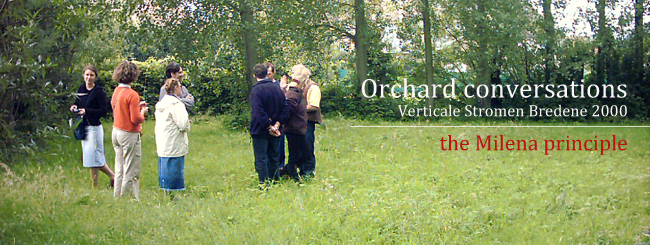
It is with both pride and a touch of amazement that we mark over 20 years of the Milena principle. The seed was planted during the 2000 art project Vertical Flows (Verticale Stromen, Bredene, Belgium), curated by art historian Filip Van de Velde and organized by Geert Vermeire. The photo above—one of the few surviving images—captures an early ‘orchard conversation’ that laid the groundwork for the project. At that time, there was no formal organization, just a group of like-minded friends who chose to collaborate regularly. That moment symbolizes the birth and ongoing evolution of the Milena principle.
Two decades later, the Milena principle has grown into a nomadic organization rooted in Belgium, yet actively engaged across Europe and beyond. We work with institutions, museums, universities, art schools, collectives, and independent artists and scholars from a wide range of disciplines.
The Milena principle was formally established during a first 'table of meetings' in early summer 2003, and soon after took public form in the exhibition Omtrent Melancholie (About Melancholy), curated by Filip Van de Velde. These moments weren’t meticulously planned—they emerged organically, and we embraced them.
Rather than arising from a predefined program, the Milena principle grew from the shared artistic journeys of its founders—a convergence of personal paths and creative experiences.
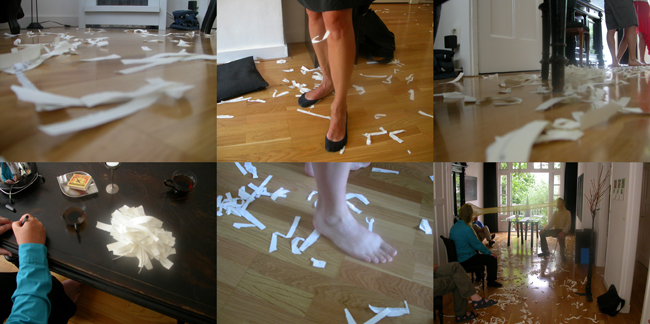
[Gepäckträger] Table of Meetings in the house of Niki Fröhling Amsterdam Netherlands 2006.
The name 'the Milena principle'?
In the old Italian language 'Milena' means 'the beloved'. The name ‘Milena principle’ refers to the return of a young Bulgarian lawyer from Sofia who decided to follow her heart after a turbulent period in the millennium. For her, this meant leaving behind a safe, settled life in her own country and a new life to be started all over again with the prospect of an uncertain future. As a nomad of a new era travelling between different cultures, she was unexpectedly present at the first lecture as a travelling companion in june 2006. This inspired the group, to see her arrival as a symbol of thinking beyond boundaries, and to link her name to the group, the projects and the lectures. So the name 'the Milena principle' was born.


In 1919 Milena Jesenská, a Czech journalist, writer and translator, discovered a short story [The Stoker] by Prague writer Franz Kafka, and wrote him to ask for permission to translate it from German to Czech. The letter launched an intense and increasingly passionate correspondence. Jesenská and Kafka met twice: they spent four days in Vienna and later a day in Gmünd. Eventually Kafka broke off the relationship, partly because Jesenská was unable to leave her husband, and their almost daily communication ceased abruptly in November 1920. They meant so much to each other, however, that they did exchange a few more letters in 1922 and 1923 and Kafka turned over to Jesenská his diaries at the end of his life.

the Milena principle. Who are we?


Anna Maria Mestdagh (B) [production assistent, photographer, webmaster], Geert Vermeire (B) [curator, writer, performance artist and managing director of the Milena principle], Stefaan van Biesen (B) [visual artist, multi media, sound artist, writer], Filip Van de Velde (B) [art historian, curator and working at S.M.A.K, museum of contemporary art Ghent Belgium], Bregt Smeets (B) [dental research, criminologist].


 Jan De Wachter †2020
In the beginning the Milena principle was shaped through the collaboration of Dr. Xue Mhin (China/B) (doctor and acupuncture), Dr. Simona Vermeire (Port/Rom) (literature critic, author, editor), Niki Fröhling (Nl/G) visual artist), Dr. Rhea Thönges Stringaris (G/Gr) (art historian and writer), Peter De Schouwer (B) (traveller and writer), Lynn Louise Pauwels (B) (research the Milena principle - VUB university Brussels, Julie Snauwaert (B) (teacher), Jan De Wachter (B) † 2022 (visual artist), Ann Meeus (B) (nurse), Sylvie Duhamel (B) (visual artist), Herman Bervoets (B) (information expert), Lutgard De Keersmaeker (B) (manager of an art gallery), Vincent Ghadimi (B) (musician and composer), Imel De Boeck (B) (pharmacist),Walter Van Dam (B) (writer), Linda Ivens (B) (education), Ingrid Pee (G) (philosopher),José Da Costa Reis (Pt) (Biscainhos Museum Braga), Margot Dieleman (B) (photographer, WIT: urban team), Eric Windey (B) (visual artist, WIT: urban team),

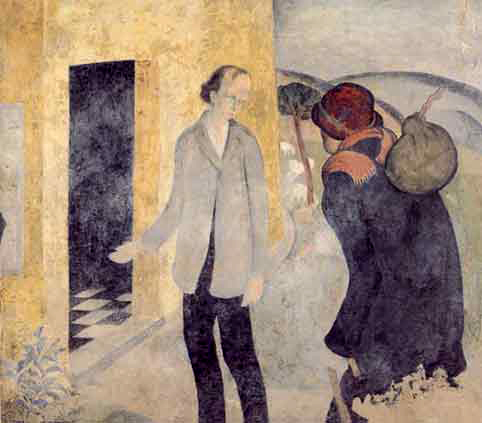
Hospitality for Strangers: an icon.
'Hospitality for strangers' Gustave van de Woestijne 1920 [ 66,5 x 74,5 cm]
© Museum voor Schone Kunsten Gent België.
• INTRODUCTION • CONCEPTS • MADE OF WALKING • FILM ARCHIVE & VIDEO • ESTATE & ARCHIVE •
